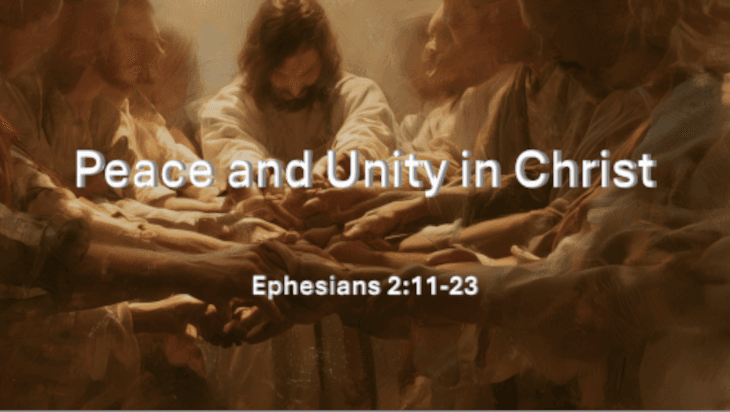
TEXT: Ephesians 2:11–22 (NLT)
Central Idea: The gospel does not merely reconcile individuals to God. Through Christ, God reconciles people who were separated from one another and builds them together into one people in whom he dwells.
Introduction — When Different Worlds Meet
It is possible for people to occupy the same building without really sharing life.
They can park in the same parking lot, worship on the same property, pass one another in the hallway, and still live in different worlds. They may speak different languages, eat different foods, sing different songs, raise their children differently, and understand church differently.
Sometimes those differences are beautiful. Sometimes they are uncomfortable.
The church at Ephesus knew something about cultural differences. Jewish and Gentile believers were not simply people with different preferences. They came from different communities- communities separated by generations of religious, cultural, and social animosity.
But here in Ephesians 2, Paul says something astonishing, astonishing at least to the believers in Ephesus:
When Jesus shed His blood on the cross, He did not simply save Jews. He did not only forgive the sins of Gentiles. He saved them individually. He saved them in the context of their ethnic cultural identities. But even though he saved them individually, Christ he unified them into a single community, one family, one people.
That makes Ephesians 2:11–22 especially important us, today, as a multicultural church. Paul shows us that unity is not just a slogan. It is not a marketing ploy. It is not something we manufacture by pretending our differences do not exist.
Unity is something Jesus Christ has already created. He has given it to His people, and We, His Church are called to live our lives out of that Spirit-given unity. Paul makes seven statements that drive this point home in Ephesians 2:11-23.
I. Paul admonishes believers to remember what once divided us.
Ephesians 2:11–12– 11 Don’t forget that you Gentiles used to be outsiders. You were called “uncircumcised heathens” by the Jews, who were proud of their circumcision, even though it affected only their bodies and not their hearts. 12 In those days you were living apart from Christ. You were excluded from citizenship among the people of Israel, and you did not know the covenant promises God had made to them. You lived in this world without God and without hope.
Paul begins with the same command we ended with in my sermon from a couple of weeks ago.
Διὸ μνημονεύετε — “Therefore remember.”
Remember what? Remember that you were outsiders. What does that mean to be an outsider?
Paul lists the bullet points:
- χωρὶς Χριστοῦ — without Christ
- ἀπηλλοτριωμένοι — excluded or alienated
- ξένοι — strangers
- ἐλπίδα μὴ ἔχοντες — without hope
- ἄθεοι — without God
This is not some kind of abstract, academic theological separation. It had a powerful real-life cultural dimension.
Jews and Gentiles had different histories, customs, religious practices, food traditions, family structures, and identities.
Paul even reminds them of the names people used for one another:
“You were called ‘uncircumcised heathens’ by the Jews…” — v. 11 NLT
Notice how the labels reinforced the division.
Here is the implication for us.
Every culture has a way of dividing humanity into “us” and “them.”
We usually think our customs are normal and other people’s customs are unusual.
- Our food is normal.
- Our music is normal.
- Our worship is normal.
- Our way of communicating is normal.
- Our way of organizing church is normal.
But much of what feels “Christian” to us may simply be Christianity expressed through our worldview and culture.
That distinction matters enormously in a multicultural church.
Application
We should never require people to become culturally like us before we recognize them as fully part of the family of God.
The gospel calls people to become like Christ, not to become like Americans or blacks or whites or browns or Republicans or Democrats. We must remember what life was like THEN– before we met Jesus, and remember the destination to which Jesus called us when He saved us.
One of the things that Jesus did when He saved us is
II. Christ brought near to God those who were far away.
Ephesians 2:13
Then comes one of Paul’s great gospel transitions:
Νυνὶ δὲ ἐν Χριστῷ Ἰησοῦ — “But now in Christ Jesus…”
Verse 13: “But now you have been united with Christ Jesus. Once you were far away from God, but now you have been brought near to him through the blood of Christ.”
Notice the contrast:
Verse 11– ποτε — once—the way it used to be, past tense/ . You used to be far from God.
versus νυνὶ δέ — but now. Today.
Since you have been saved, you have been brought near.
And:
Used to be: μακράν — far away—
Since Christ: far away becomes ἐγγύς — near.
What caused the change?
- Not education?
- Not cultural assimilation?
- Not learning the dominant language?
- Not adopting Jewish customs?
No. The change occurred at the cross, through the blood of Christ. The cross becomes the place where the isolated, Christless, Godless, excluded, alienated, strangers without hope, came near to God.
Illustration
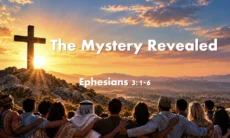
Imagine people standing in a large circle around a cross.
Some begin a long way from one another. But as everyone moves toward the cross, something happens. They also move toward one another.
That is Christian reconciliation–Christ brings us to God—and in bringing us near to God, he brings us near to one another.
III. Christ Himself is our Peace.
In Ephesians 2:14–18, Paul says
14 For Christ himself has brought peace to us. He united Jews and Gentiles into one people when, in his own body on the cross, he broke down the wall of hostility that separated us.”
Paul does not merely say Christ gives peace. He says that:
“Christ himself has brought peace to us.” — v. 14 NLT
Literally: “He himself is our peace.”
That is stronger than simply giving peace to us. Peace is not a commodity, doled out when we pay the price. It is not a reward the God gives us for participating or achieving anything. It is a gift from God.
He united Jews and Gentiles into one people when, in his own body on the cross, he broke down the wall of hostility that separated us.
Our unity ultimately does not result from our ability to understand one another, to use the same words or have the same practices or preferences.
Our unity is a Person.
Look at what he says in vv. 14-18
A. He made the two one — v. 14
“He united Jews and Gentiles into one people.” Two hostile communities have become one.
But notice what Paul does not say.
- Gentiles became Jews.
- Or Jews became Gentiles.
Instead, something new happened.
B. He destroyed the wall — vv. 14–15
Paul says Christ: “broke down the wall of hostility that separated us.”
The image probably would have been especially powerful for Paul’s readers because barriers in the Jerusalem temple visibly separated the Court of the Gentiles from areas reserved for Jews.
Paul says Christ has destroyed the barrier.
The important word is: ἔχθρα — hostility.
Christ does not merely teach hostile people to tolerance of one another.
Through the cross, he actually kills the hostility itself.
Verse 16: “He brought an end to hostility.”
There is a profound implication here.
We cannot celebrate the cross while rebuilding walls that Christ died to tear down. The peace that passes all understanding becomes ours only by the grace of God.
IV. Christ creates one new humanity—vv. 2:15–16
This may be the theological heart of the passage.
15 He did this by ending the system of law with its commandments and regulations. He made peace between Jews and Gentiles by creating in himself one new people from the two groups.
16 Together as one body, Christ reconciled both groups to God by means of his death on the cross, and our hostility toward each other was put to death.
Paul says Christ acted:
“He made peace between Jews and Gentiles by creating in himself one new people from the two groups.” — v. 15 NLT
Notice: τοὺς δύο — the two different groups become
ἕνα καινὸν ἄνθρωπον — one new humanity.
Paul does not say that one culture absorbed the other. Christ created something new.
That has enormous implications for a multicultural church.
- Biblical unity is not: Sameness. It is not identical spiritual twins.
- It is not Assimilation.
- And it is not merely Tolerance.
It is reconciliation in Christ that allows genuine differences to exist inside a deeper unity.
In Revelation 7:9. John sees:“a vast crowd, too great to count, from every nation and tribe and people and language.”
Notice something fascinating. Their cultural identities have not disappeared. John can still recognize: nations, tribes, peoples and languages. The gospel does not erase human diversity.
It redeems it.
V. We All Have the Same Access to the Father–vv. 2:17–18
Paul’s unity language becomes almost rhythmic:
17 He brought this Good News of peace to you Gentiles who were far away from him, and peace to the Jews who were near. 18 Now all of us can come to the Father through the same Holy Spirit because of what Christ has done for us.
Look at the way Paul phrases it:
- δι’ αὐτοῦ — through him
- οἱ ἀμφότεροι — both
- ἐν ἑνὶ πνεύματι — in one Spirit
- πρὸς τὸν πατέρα — to the Father.
- We have Christ.
- We have the Spirit.
- We have the Father.
- And both groups have exactly the same access.
There are no second-class Christians.
- No preferred ethnicity.
- No preferred nationality.
- No preferred language.
- No preferred culture.
- At the foot of the cross, nobody possesses a better entrance to God.
“There is no longer Jew or Gentile, slave or free, male and female. For you are all one in Christ Jesus.” — Galatians 3:28 NLT
VI. Strangers have become family–Ephesians 2:19
19 So now you Gentiles are no longer strangers and foreigners. You are citizens along with all of God’s holy people. You are members of God’s family.
Paul now changes his metaphor.
He began by speaking about: ξένοι — strangers.
Now he says: “So now you Gentiles are no longer strangers and foreigners.”
Instead you are: συμπολῖται τῶν ἁγίων fellow citizens with God’s people.
But Paul goes further: οἰκεῖοι τοῦ θεοῦ. He says you are members of God’s family.
That progression matters. We are not merely people who have permission to enter the same building. We belong to the same household.
Implication for a multicultural church
A multicultural church cannot simply say: “You are welcome to worship here.” Come and be just like us. Hang out awhile.” That’s hospitality.
- Family says something stronger: “You belong here.”
- Hospitality says: “Come into my house.”
- Family says: “This is our house.”
That is a much deeper kind of unity.
VII. God is building us together– Ephesians 2:20–22
20 Together, we are his house, built on the foundation of the apostles and the prophets. And the cornerstone is Christ Jesus himself. 21 We are carefully joined together in him, becoming a holy temple for the Lord. 22 Through him you Gentiles are also being made part of this dwelling where God lives by his Spirit
Now Paul changes the image one final time.
- We were strangers.
- Then citizens.
- Then family.
- Now we become building materials.
- “Together, we are his house.” — v. 20 NLT
Christ Jesus himself is:
ἀκρογωνιαῖος — the cornerstone. Everything is aligned with him.
Then comes the crucial word in verse 22:
συνοικοδομεῖσθε “you are being built together.”
Not merely: You are being built. But:
You are being built together.
And God’s purpose is: εἰς κατοικητήριον τοῦ θεοῦ ἐν πνεύματι “to become a dwelling in which God lives by his Spirit.”
Here Paul’s argument reaches its climax.
The people who were once far away from God have now become the very place where God chooses to dwell.
Conclusion — What Kind of Church Is Christ Building at Forest Meadow?
Ephesians 2 gives us a remarkable progression:
- Far away → Brought near
- Enemies → Reconciled
- Two peoples → One new humanity
- Strangers → Citizens
- Foreigners → Family
- Separate people → One temple. And behind every movement stands Jesus Christ.
- His blood brought us near.
- His cross killed the hostility.
- His body reconciled us.
- His Spirit gives us access.
His presence makes us one.
For a multicultural church, then, our diversity is not a problem that must be solved. Neither is diversity by itself the goal.
The goal is reconciliation in Christ.
- We do not have to speak the same language.
- We do not have to sing the same songs.
- We do not have to eat the same foods.
- We do not have to share the same history.
- We do not even have to understand every part of one another’s culture.
- But we must recognize something deeper:
If Christ has received my brother/ sister, I must receive them too.
And perhaps the greatest implication of this passage is contained in one little Greek prefix:
- συν- — together.
- συμπολῖται — fellow citizens.
- συναρμολογουμένη — joined together.
- συνοικοδομεῖσθε — built together.
Christ is not building several unrelated houses that happen to stand on the same property.
He is building us together.
And when a church composed of different nations, languages, generations, histories, and cultures learns to live as one new humanity in Christ, the world sees something it cannot easily explain:
People whom the world expects to remain separated have become family.
And Paul tells us why.
Αὐτὸς γάρ ἐστιν ἡ εἰρήνη ἡμῶν. “For Christ himself is our peace.”
J. Timothy Ahlen
October 4, 2026